Checked 2026-10-24. Six China-origin model developers, five overseas developers and one overseas hosting platform. All token rates are per 1 million tokens. ¥ means CNY and $ means USD. Platform names link to official pricing.
Understand the bill first
Input includes prompts, conversation history, tool results and file contents supplied to the model. Output includes the answer and chargeable reasoning tokens under the provider’s rules. Token counts differ from character counts and between tokenizers.
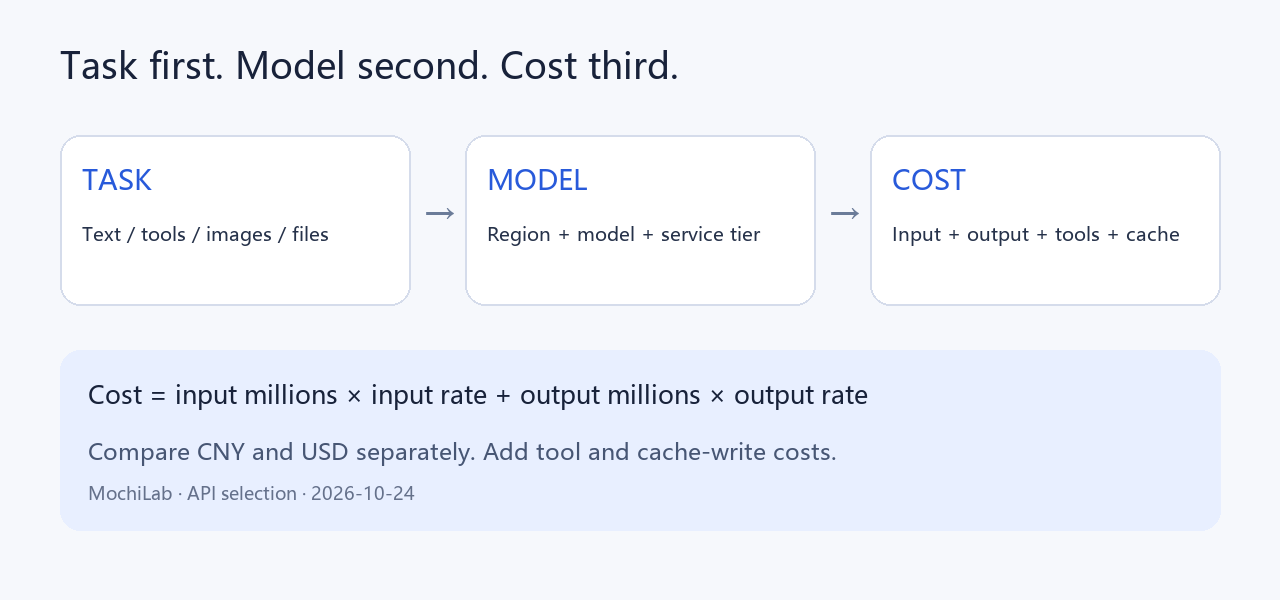
Base cost = input tokens / 1M × input rate + output tokens / 1M × output rate. These are regular pay-as-you-go quotes with cache hits noted separately. Batch, priority service, search and generated media can have separate charges. Chat memberships and coding subscriptions are separate products.
China-origin model developers
Grouping follows the developer’s origin, not the billing location. GLM uses a Z.ai international USD quote. Kimi’s dynamic direct-price table did not expose numeric rates during this check, so its official link is provided rather than an old model’s price.
deepseek-flash: input ¥2 / output ¥8, per 1M tokens.
Chinese tasks, reasoning, image understanding and tool calls; a practical starting point for everyday agents and Skill tests. Direct, peak hours; off-peak ¥1 / ¥4. Cached input ¥0.04 / ¥0.02.
qwen3.8-flash: input ¥0.8 / output ¥2.7, per 1M tokens.
The Qwen family covers general text and multimodal work. Choose Flash, Max or a modality-specific model for the task. Beijing region, input ≤1M; Singapore pricing differs.
doubao-seed-2.1-lite: input ¥0.8 / output ¥2.7, per 1M tokens.
Doubao and hosted models share one platform. Select and price text, audio and video services separately. Regular online, non-audio input ≤1024K; cached input ¥0.16, storage extra.
MiniMax-M3.1-Flash: input ¥1 / output ¥4, per 1M tokens.
Offers text models plus separate speech and video services. This quote covers the text model only. China platform; cached input ¥0.10.
GLM-5.3-Flash: input $0.15 / output $0.50, per 1M tokens.
GLM models serve text and agent workflows. Distinguish BigModel China from international Z.ai accounts, endpoints and pricing. Z.ai international USD quote, not a China-region CNY quote; cached input $0.03.
kimi-k3: see the official page for direct pricing.
K3 targets long context, documents, vision and multi-step tool work. Direct API billing is separate from Kimi and Kimi Code subscriptions. See the direct platform’s dynamic price table; a verified hosted quote is given below.
DeepSeek peak hours are Beijing time Monday–Friday, excluding Chinese statutory holidays, 09:00–12:00 and 14:00–18:00. All other times are off-peak. Alibaba and Volcano quotes apply to the specified region and regular online service.
An alternative Kimi route: Together-hosted Kimi K3 costs $3 input / $15 output, with $0.30 cached input per 1M tokens. These are Together charges, not Kimi’s direct CNY rates. Hosted model and pricing ↗
Overseas platforms
gpt-6.1-sol: input $2 / output $10, per 1M tokens.
General reasoning, code, structured output and tool workflows. Luna is another option to test for simpler high-volume work. Standard, short-context tier; cached input $0.10.
Claude Sonnet 5.5: input $2 / output $10, per 1M tokens.
Useful candidates for code, writing and sustained tasks. Sonnet, Opus and Haiku offer different cost and workload choices. Base rates; cache hits $0.10, 5-minute writes $2.50.
gemini-4-argon: input $2 / output $10, per 1M tokens.
Argon targets complex engineering, maths, science and multi-step agents. Select the relevant Gemini model for image, audio or video work. Standard promotion through 2026-11-30; $4 / $20 from 2026-12-01.
Mistral Small 4: input $0.15 / output $0.60, per 1M tokens.
Alongside general models, Codestral, OCR and speech APIs let you select distinct services for document and code tools. Standard; cached input $0.015.
grok-4.7: input $2 / output $6, per 1M tokens.
Text, reasoning and tool workflows. Enable the relevant search tool for web or X data and include its separate charges. Global endpoint, input <200K; ≥200K costs $4 / $12.
gpt-oss-120B: input $0.15 / output $0.60, per 1M tokens.
Hosts open models from multiple developers. Check the model author, hosting provider and billing provider separately. Serverless hosting quote; not OpenAI’s direct GPT API pricing.
Include Gemini Argon’s promotion end date in ongoing budgets. Grok’s US regional endpoint charges 1.1 times global token rates. OpenAI uses the Standard short-context tier here; select the relevant long-context or service-tier quote for other requests.
What would 100 million tokens cost?
Assume a monthly total of 80M input + 20M output, spread across requests that qualify for the quoted tier, without cache hits or extra tools:
- DeepSeek Flash, entirely peak / entirely off-peak: ¥320 / ¥160
- Qwen3.8 Flash, Beijing: ¥118
- MiniMax M3.1 Flash, China platform: ¥160
- OpenAI gpt-6.1-sol, Standard short-context tier: $360
- OpenAI gpt-6-luna, same service and context tier: $18
These are workload calculations, not monthly plans. Cache use, reasoning length, retries and each request’s tier change the bill.
Choosing for OpenClaw and Skills
These are suggested evaluation starting points:
- Chinese everyday agents and free Skill tests: try DeepSeek Flash, Qwen Flash, Doubao Lite or MiniMax Flash on your own tasks.
- Complex code and multi-step tools: compare GPT Sol, Claude Sonnet, Kimi K3 and GLM on completion, elapsed time and total cost for identical tasks.
- Long documents, charts or media: check the exact model’s modalities, context limit and billing units. A platform’s feature catalogue is broader than any single model.
- Comparing open models: Together can host several candidates; record the model, host and route price separately.
Run three tests: create a file and read it back; finish a task requiring successive tool calls; extract numbers from a file and verify their sources. Record completion, first-token wait, total time and cost before choosing a primary and fallback model.
Tools execute a Skill’s file processing, backup and conversion operations. The model must select tools, supply correct arguments and inspect results. Chat fluency alone does not establish workflow reliability. Configure model, search-service and memory-embedding credentials separately when required.
Five checks before connecting
- Supported account/server regions and acceptable latency.
- Exact model ID, API protocol and OpenClaw version; test tool calls even on compatible interfaces.
- Spending alerts and limits, starting with a small top-up.
- Private server-side key storage; redact credentials and personal data from screenshots.
- Context tiers, concurrency, cache writes/storage, search and media fees; compare metered APIs separately from subscriptions.
This is a 2026-10-24 price snapshot with task-based selection suggestions. Confirm the region, model and service-tier quote when activating a service.